Sunday, February 23, 2014

Safe Spaces: Hyperlink


The reading for this week which was Safe Spaces by Annemarie Vaccaro, Gerri August, and Megan S. Kennedy was great. I really liked it, because it made me think a lot about the struggle that the LGBT community goes through. It is unfortunate how they have to be marginalized and ignored. It isn’t fair. Most importantly it made me think about how true this article is, in the sense that in school I never really had the LGBT topic mentioned. As a future educator I do see the need of really having that topic mentioned, to prevent generations of children from discriminating and bullying other classmates or individuals simply because of their sexual orientation.


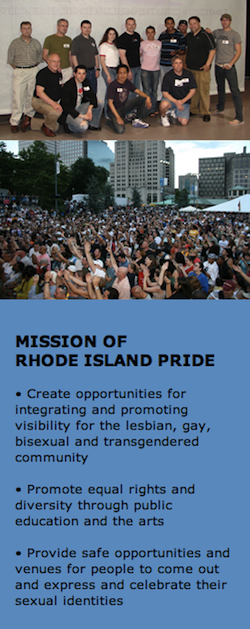
For this week’s reading I decided to relate it to a hyperlink. Just when I typed LGBT in google trying to find a way to put all of my ideas together, the first thing that  came up was this cool website and organization http://www.prideri.com/?page_id=9  it’s called RI Pride, which is an organization that helps the RI LGBT community be represented and not discriminated against. At the same time it also helps them embrace who they are.

Trying to stop the discrimination and marginalization as mentioned in the reading against the LGBT community, in 1976 people who believed in educating the larger community about the struggle and rights of people with different sexual orientations but that at the same time believed in having the LGBT community embrace who they are and what their preferences are, created the first ever pride parade in RI.  State and City leaders attempted to block the parade, but they couldn’t. In the first ever pride parade 75 people marched through downtown Providence and eventually they formed the RI Pride organization. Events such as the RI pride parade helped with the “gay liberation movement” and also with the movement to extend civil rights protections to gay men, lesbians, and bisexuals in 1995, and also to transgender individuals in 2001.  


Today the RI Pride has over 25,000 members, even though it started with less than 100 members.

RI Pride has a lot to do with Safe Spaces. The way I connect both of them is that in Safe Spaces we learn about how marginalized the LGBT community is, but in the RI Pride website we learn about all of the activities they organize in order to stop that discrimination. RI Pride organizes “seminars, rallies, performances, theme events, art, and literacy programs, and projects” in order to stop the discrimination and bullying against the LBGT community, that as we see in Safe Spaces a lot of the time it sadly starts within the classroom and in schools all throughout America. .


http://www.youtube.com/watch?v=MnB6FgDz0Lk This is a link to RI Pride TV which is a series of videos in YouTube to help the public better understand the RI Pride organization and how they help the LGBT community.


As I mentioned before Safe Spaces and the RI Pride organization have a lot in common. In Safe Spaces we learn about how all throughout America students from K-12 are not informed about concerns and issues relating to the LGBT community. Perhaps this lack of information and this invisibility is what causes generations to continue having wrong ideas and opinions regarding the LGBT community, and thus creating a system of discrimination and bullying. Such system causes the death of many people such as “Justin, a promising musician [who] was bullied because of his sexual orientation, [causing him to take] his life after finishing his freshman year”. We continue on learning how the LGBT community is not represented in the curriculum, meaning that they are not represented in school. With a lack of representation in the curriculum they are not like the other students who do actually “see themselves as wise or powerful main characters or heroes worthy of celebration and emulation [and that] will feel validated, included, and safe inside their classrooms”.  Typical marriages are they only ones discussed, and at times even teachers with good intentions don’t know how to explain or represent the aspects of the LGBT community. As we see all of this creates students with a lack of understanding of LGBT concepts and thus we create a community who discriminates against their own fellow brothers and sisters.  This is where organizations like RI Pride come in, to make a change, and help “individuals in Rhode Island to learn about the issues, concerns and contributions of sexual minorities”. Most importantly trying to help with what sadly goes on in schools “The PrideFest also includes an education and interactive recreational area called theKid’s Pride Zone to provide GLBT parents a place to engage in family oriented activities with their children at the festival” that they organize each year celebrating who they are and what they represent.  Thankfully we have organizations like RI Pride who fight for equality.


Sunday, February 16, 2014

Aria by Richard Rodriguez: Reflectiom


The reading for this week was definitely a reading I truly enjoyed. Perhaps it was because it’s about a topic that I can relate to, and that I am passionate about. When reading Aria by Richard Rodriguez so many thoughts came to my mind. I had tons of ideas and things to say about the article yet I didn’t know how to express them. Trying to help myself come up with something to write about, I looked to the list of topics we have to write blogs about, and I just couldn’t help myself from writing a reflection.

I can honestly relate to how it feels to be a bilingual student. From appearance I simply look white, and I am,  but I am also half Hispanic. I have family from Mexico, a family that has showed the value of keeping my culture, from eating spicy food to never forgetting how to speak Spanish. For my grandparents and parents it was extremely important for me to learn Spanish, so that our family history and traditions can be passed on from generation to generation. Their desire for me to learn Spanish was such that ever since I was little they taught how to speak it, write it, and read it. I was in a bilingual classroom up to fifth grade. Perhaps at times I was confused but I loved the feeling of having two worlds. Speaking English at school with a little mix of Spanish and coming home and being able to communicate in both languages, but mainly practicing my Spanish at home.  So I can totally understand how Richard must have felt when he lost that contact with his family, because they communicated just in English after always having communicated in Spanish.

 I can’t imagine myself coming home and not hear my parents say my name the Spanish way, or not talk to my parents in Spanish a lot of the time. It would not feel like home, to not hear the Spanish news at times, or my grandfather talk about his stories in Spanish over the phone or my aunts and uncles not listen to their Mexican music. When Richard talked about not being eager to get home anymore, or his dad becoming “shy” simply because he didn’t want to speak English, it made me sad, and I could totally see myself in that situation, which would make feel exactly the way Richard felt. I would feel like something was missing, I would miss my two worlds a lot!


 I think it is important to fit in society, to encourage our children to learn English, and to practice with them. I know it is important and essential for children to  learn the official language of our country and do it well, as well as it is important to have children who are confident in what they speak and how they do it, but at the same time I believe that we just can’t completely take their other culture away from them. As much as it important to have a public identity, we can’t completely sacrifice the private identity at home or with family. After reflecting from my own life and after reading this article I truly believe that there must be a balance. One where parents such as Richard’s try to speak with their children in English, and practice with them so that their children can be successful in school, but at the same time I think it is important to have parents show and teach their children about their cultural background and language. I know there can be a balance, I am prove of that.


The points I would like to talk about in class are the advantages and disadvantages we see as future educators in having our students’ parents do what Richard’s parents did, and enhance the English language all of a sudden, and leaving behind their native language.


The link below is about the advantages of being bilingual:


Sunday, February 9, 2014

The Silenced Dialogue: Connections with other Past Readings


Reading the Silenced Dialogue by Lisa Delpit was definitely a challenge. It was hard to read and hard to understand at same time. My brain was like this...

Yet, after reading it several times, or going back to certain paragraphs, or lines, to help me understand it, I started to connect the reading to other past articles we have read in class. Once I started understanding it, it all made sense. Ideas kept coming to my mind relating this reading not only to past articles but also to trends that I see around schools I have visited. For instance, how the majority of teachers are white in places where the majority of students are black or non-white. Also I started to think about the Impact that having black teachers might have for black students. Those ideas are some points I would like to bring to the class discussion, because this article really made me think about that, how black students from all ages don’t have many black role model teachers to look up to, and I wonder why there aren’t many black teachers, and if there were. I wonder the impact it might have. 
 
The Link below expresses that idea of how teacher diversity does matter.
As I mentioned, what really helped me understand The Silenced Dialogue was relating it to the past readings we have done in class, especially White Privilege by Peggy McIntosh and Privilege, Power, and Difference by Allan Johnson. The article started off by stating how white teachers “listen but don’t hear”. They don’t hear and simply don’t want to hear what black educators have to say. They simply nod and move on, they think that they know to educate all kinds of students, forgetting that perhaps black teachers have more to say because they can relate to their black students. White teachers can try to understand, but they don’t have that first- hand experience, therefore Instead of blocking black educators, they should appreciate their insight and try to use their advice to be more helpful to black students.  In Privilege, Power, and Difference by Allan Johnson, he mentioned that whites “don’t want to look at what the words point to, [that simply] people don’t want to look because they don’t want to know what it has to do with them and how doing something about it might change not only the world, but themselves”.  This idea helped understand perhaps why white educators don’t want to hear. Why they refuse to admit that they don’t know everything and that advice from their black colleagues is needed, and why they simply nod and don’t care.
Therefore after being ignored so many times black teachers stop communicating, resulting in the lack of a mutual agreement between teachers to help their students, not just having the “privileged group” make the decision for all. This reminded me of the “obliviousness [that exists] about white advantage that serves to keep power in the hands of the same groups that have most of it” as it was mentioned in White Privilege. Perhaps white educators have the best intentions, but they have to stop and realize that change is needed, that we can’t just have them make the decisions alone without considering the opinions of black teachers. That is why “several black teachers cannot help but conclude that many of the “progressive” educational strategies imposed by liberals upon black and poor children could only be based on a desire to ensure that the liberals’ children get sole access to the dwindling pool of American jobs”. We can’t and educators certainly can’t let things be the same, and let the privileged continue to be so, and the unprivileged to lack the support and help they need.
The picture below shows the percentage of teachers in United States by race/ethnicity and sex. IT shoes the lack of black and non-white teachers in he education system.


Number and percentage distribution of full- and part-time public school teachers, by race/ethnicity and sex: 2007–08

Sex

Total

White

Black

Hispanic

Asian

Pacific Islander

American Indian/Alaska Native

Two or more races

Number (in thousands)

Total

3,405

2,829

239

240

42

6

17

31

Male

821

685

56

58

9

1

4

8

Female

2,584

2,145

183

182

33

5

13

24

Percentage distribution

Total

100.0

83.1

7.0

7.0

1.2

0.2

0.5

0.9

Male

100.0

83.4

6.9

7.1

1.1

0.2

0.5

0.9

Female

100.0

83.0

7.1

7.0

1.3

0.2

0.5

0.9
SOURCE: U.S. Department of Education, National Center for Education Statistics. Schools and Staffing Survey, "Teacher Data Files,” 2007–08, unpublished tabulations.


Sunday, February 2, 2014

Mott Haven: Quotes


Amazing Grace written by Jonathan Kozol perhaps has been one of the most eye-opening articles I have ever read. I can’t express enough how much I liked the article and how much it made me realize of the suffering taking place in one of the most “racially segregated concentrations of poor people in our nation”. It made feel angry and most all it made me feel a lot of indignation. Some of the points that I would like to speak about in class are perhaps the ones that made me feel the most mad about, and they are the facts that NY is seen as a great place, with amazing things, and all the time in the media we hear things about Times Square, Broadway and many other fancy and luxurious things and places, but what about the poor people, what about the people that suffer and aren’t as privileged as starts or celebrities who are always in the media? Who mentions them? Sadly that’s why people like me never had heard about places like Mott Haven, because they don’t receive the attention other things do get. It is not fair! Additionally, all the segregation, the lack of education and sanitary conditions, along with unfairness of all kinds, take place and the government didn’t and perhaps now they don’t do enough, but why? Why didn’t they help? Why were more sick and poor people sent there as if trying to forget them and isolate them? Where was the help?
Now getting to the article, there were many things that stood out to me. It is definitely hard to just choose some quotes that impacted me, because overall the article was so touching. This article made clear the injustices that the residents of Mott Haven had to go through. To begin with, the level of poverty is so high that only “seven of the 800 children [in the town elementary school]  did not qualify for free school lunches [and] five of those seven get reduced-price lunches, because they are classified as only “poor” not destitute”.  For me this was such a sad fact, just to know that all those children have to get school lunch, because they do not have enough money to eat well. I can just imagine them hungry and this intruding in their education, simply because they were being segregated in a town without opportunities. Another part of the article that really impacted me a lot is the discrimination against poor people that causes waste incinerators to be put in their towns, such as in Mott Haven, simply because they don’t have the representation needed to stop such injustices. We don’t see waste incinerators being placed in rich neighborhoods, but instead in the poorest ones. The waste incinerator in Mott Haven, burned “so-called “red-bag products” such as amputated limbs, and fetal tissue transported [there]] from 14 NYC hospitals”.  Originally it was scheduled to be put in the East Side of Manhattan, but it wasn’t put there because “a burner there had been successfully resisted by the parents of the area because of fear of cancer risks to children”. This really made me mad! What about the children in Mott Haven, what about their health? The discrimination against the poor shouldn’t be happening. Lastly, the lack of help provided for the people by the hospitals was unbelievable. In Lincoln Hospital, which was the one attended by the residents of Mott Haven, had at least “12 people, including two infants [that] died because of staff mistakes”. In a town full of sick people, people with AIDS, children suffering with malnutrition the only help they had, were inadequate hospitals, with nurses who took thirty minutes to provide help, and that worked two consecutive shifts nonstop.
As I said before this was the most eye-opening article I have read.

The image above shows the living conditions describes in the article. In this picture we can clearly see how the buildings are all next to each other, which made people not receive enough fresh air depending on their location of the building.
 

As it is states in my post, one of the things that impacted me the most was the waste incinerator in Mott Haven, therefore the image and link above show the residents of Mott Haven fighting to close the incinerator in their town.
 

Wednesday, January 29, 2014

Introduction: About me


Hello everyone! I am Maritza, the youngest of three siblings. My sister Alicia is eleven years older than me, and my brother Ulises is nine years older, so basically for most of my life I grew up as an only child, i recently turned 18, which was something I was quite excited for. Over the summer I worked at Disability Determination Services (DDS) in downtown Providence, and met awesome people. Although they were older and most of them were parents, they made sure I had fun during my summer break and certainly made me feel at home. In my last day of work they took me out to eat, and I miss them. That job certainly made me more responsible and appreciative of the people I meet. When I am not in school, and especially when I have free time I love to just relax and watch movies or spend time with my friends and family. Yet, one of the activities that  I used to do, and that I loved was volunteering at INSIGHT, a place that showed visually impaired children in RI independent living skills, and how to advocate for themselves. Volunteering there definitely inspired me in wanting to become a special education teacher one day. The awesome and inspiring children that I met there made me want to make a difference in the life of children with disabilities in the future. I am taking this class because it's required for my major, but I also think it will definitely be a fun class and I look forward to see what this semester brings.